What’s Wrong With Grain Free Kibble?
Dr. Karen Becker is a renown veterinarian who has a reputation for her proactive approach to animal nutrition. She is passionate about educating pet parents and does so through videos, articles and books. In her latest video on Mercola.com she covers the topic of the increasingly popular grain free kibbles. Take a look:
Video: What’s Wrong With the Newest Grain-Free Craze?
The FDA’s Salmonella Scare
The raw pet food industry is regulated by the FDA. This is because pet food is considered to be a ready-to-serve product where the chicken you buy from your butcher is not. Recently the FDA feels that regulations on the raw pet food industry needs to be changed and that “certain criteria should be considered in recommending enforcement action against animal feed”. In other words they want to do more testing on pet food and determine if they should reject food with very minute amounts of bacteria.
Here’s the problem; bacteria is good for your pet. Their natural diet is to eat dead carcass meat. Their intestinal tract needs this bacteria to be strong so that it can fight of more harmful bacteria. If you feed raw, you know this.
Last month the FDA put out a notice saying that it is accepting feedback from consumers, manufactures, retailers, veterinarians and anyone else with an opinion on this subject. This comment period was to end soon, but because of the gravity of this kind of decision they have extended the commenting period. This extension was announced shortly after the release stating the FDA will be doing random tests on pet food in 2011.
It is so important that everyone from consumers to animal health exporters weigh in on this issue. We know bacteria is a good thing in limited amounts. Therefore we are very clean in our production and careful in where we buy our ingredients. We go to extreme measures to ensure that even when the product leaves our plant is is kept at below 0 temperatures to maintain it’s safety. If the FDA starts rejecting food with any level of bacteria then they will be choking the raw industry and you may have to start buying your raw pet food from a bootlegger.
Please submit your comments to the FDA and to us.
Docket Folder at regulations.gov – go here to find out more about this issue.
The Growing Market Demand for Raw Meat Diets
More and more pet owners are realizing the benefits of a raw diet, but either do not have the time or worry about contamination and do not desire to make it themselves. The demand for a properly prepared, complete diet, raw meat pet food is growing exponentially.
First, let’s define properly prepared raw meat diet?
“Complete and balanced foods or feeding programs, using high quality ingredients, and processed and handled according to human standards. Commercial products have clearly marked safe handling instructions.”
Please note these are not all-meat diets, they are complete and balanced foods or feeding programs.
There are three different types of properly prepared raw meat-based diets.
* Feeding programs of raw food, which may include raw bones, from Pat McKay, Wendy Volhard, Kymythy Schultz, and Ian Billinghurst.
* Well thought out homemade recipes, from Dr. Richard Pitcairn and others, often using packaged mixes.
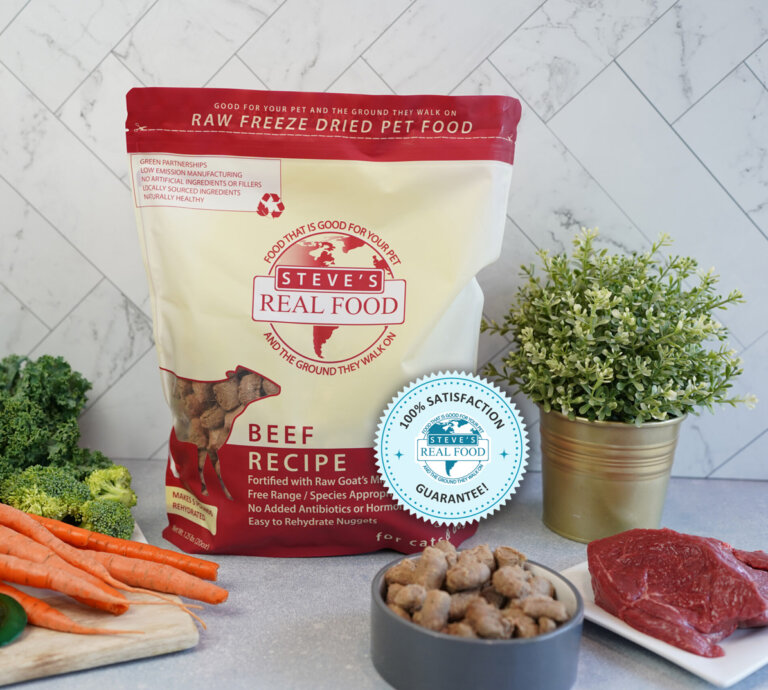
* Complete and balanced commercially available foods meeting AAFCO guidelines, like AFS, and Steve’s™ Real Food™ for Pets.
All of these are based on a diet such as might be found in the wild. Think of the dog eating a mouse or rabbit. The dog would eat raw meat, crushed bones and the prey’s digestive system, which would be full of finely crushed vegetables and fruits, and food and digestive enzymes.
The raw meat feeding programs vary. Some of the feeding programs and diets contain grains. Most do not. Many advocates of raw feeding believe that dogs and cats do best with almost no grains. Some use whole raw bones (chicken backs, turkey and chicken necks, chicken wings), some use crushed bones, and some add other sources of calcium and phosphorous.
Please note that we are not talking about what may be fed to greyhounds to enhance their racing performance. We’re not dealing with 4D meats. We’re talking about diets, using high quality ingredients, fed to dogs to enhance their overall life span and health. Although the number of diets on the market is small, some of these diets have been fed for many generations.
Properly prepared raw meat-based diets are expensive: Costs range from equal to the cost of super-premium foods for great shoppers and cooks, to three times the cost of super-premium foods for some of the commercial raw meat-based diet brands. To reduce cost, many people mix raw diets with a traditional dry food.
Raw feeding programs have been around for a long time and are well proven. Julie de Barclay introduced a complete feeding program in 1955. Subsequent feeding programs have been used over the last 40 years and for many generations of dogs and breeds. These programs include lots of variety, every meal different. Most BARF and Ultimate Diet feeders are very disciplined. Few BARF feeders mix the full weeks ingredients together as the speaker yesterday suggested. BARF feeders believe in the BARF program. In my opinion, when done right, the feeding programs like BARF and Kymythy Schultze’s are the most nutritious, and most palatable ways to feed dogs, perhaps even better than Steve’s Real Food. They do take time and preparation. Many people, though, want the same convenience with a raw meat based diet as they find with other dog foods.
The commercially made raw meat-based diets were developed to fill this need. They are formulated to meet or exceed AAFCO profiles for all life stages.
The commercially prepared raw meat diet manufacturers want the same things as other pet food companies – nutrition and safety. This is why some brands are presently, or will soon be, conducting AAFCO protocol feeding trials. And why some companies have joined the Petfood Institute.
How safe are properly prepared raw meat-based diets?
This question covers two subjects. One, how safe are properly prepared raw meat-based diets for dogs and cats; and two, how safe are they for humans to handle.
Over the last two years, we’ve seen many formerly skeptical veterinarians, breeders and retailers accept the fact that properly prepared raw meat-based diets are safe for dogs.
When I give my dogs bones – usually raw turkey necks – my puppy usually buries hers. A week or so later she’ll eat it. I can guarantee you that the bone is full of bacteria. But the puppy loves it and thrives on it. I hate to admit it, but week old turkey necks are still her favorite food.
We all know that raw meat has bacteria, most beneficial and some not. We also know that these bacteria do not pose a substantial risk to the dog under proper conditions of use. The short digestive systems of dogs allow them to stay healthy in the presence of potential pathogens.
Commercially made properly prepared raw meat-based diets have an excellent safety record. In the Northwest, where a lot of people feed raw meat diets, I’ve talked to all the retailers that sell raw diets, know all the distributors, I’ve done seminars in the stores, exhibited at veterinarian conferences, and met many thousands of consumers. Raw meat feeders are increasingly Internet connected. Word of mouth spreads quickly. If there were problems, my retailers would know about them and I would know. Indeed, our market keeps growing, success story after success story, retailer after retailer.
Our market and the growing number of raw meat feeders nationwide believe that properly prepared raw meat-based diet are as safe to handle as any raw meat product, like hamburgers, steaks, ribs and so forth. As with any raw human food product, safe handling instructions are important. Steve’s Real Food safe handling suggestions state:
“Treat as you would any raw meat product. Keep away from small children. Clean your hands, the dog bowls and all utensils in hot soapy water.”
Steve’s Real Food, like all properly prepared raw meat-based diets, takes extra care to ensure safety.
First, we use all human edible ingredients and handle the product according to human-edible standards.
Second, we manufacture the product in refrigerated rooms, keeping the temperature of the product below 28 degrees F during forming. We then individually quick-freeze, or flash freeze, at about –50 F wind chill, our ¾” nuggets. This not only locks in taste and nutrition it also minimizes opportunity for microbial growth.
Third, we make the food very easy to serve and clean up. Our nuggets are almost as easy and safe to serve as kibble, and certainly easier—and cleaner—than canned dog food. No can openers, utensils or cutting surfaces are needed.
To serve, most of our customers open their freezer, take out the bag, pour the right number of nuggets either directly into the dog’s bowl and serve, or into another bowl and defrost in the refrigerator. Most of our customers, we believe, defrost just what the dog needs for the next meal. This minimizes any mess in the refrigerator.
In addition, the flash frozen nuggets keep their shape in the dog’s bowl. The dogs eat them cleanly and quickly. We all know how much most dogs love real meat!
Why the market thinks raw meat-based diets are highly nutritious.
Results. They see how healthy dogs are on properly prepared raw meat-based diets.
We, in fact, believe there are many advantages to properly prepared raw meat-based diets.
Raw foods contain more of the nutrients found naturally in the starting ingredients than those that have been heavily processed through canning, extrusion, drying, acid treatment or some other process. Please understand that we are not saying that traditional dog foods lack nutrition. We are simply saying that there is more nutrition in minimally processed raw foods. That is why many of our customers often shop at farmers’ markets and natural food stores. They believe the taste and nutrition of fresh, whole foods is better for them and their pets.
To best understand the quality of these diets, let’s look at the ingredients in Steve’s Real Food for Dogs, my product. Other commercial products have similar ingredients.
This food is about 60% human quality chicken, 38% human quality vegetables and fruits, and 2% a special nutrient blend.
Delicious and wholesome. We’d all probably wish we, and our children, ate so well. Since the product is raw, produced in refrigerated rooms and flash frozen, the nutrients remain intact. As you might surmise, this product was formulated to meet the nutritional levels established by the AAFCO dog food nutrient profiles for all life stages.
Raw foods contain numerous substances – including enzymes and complete families of antioxidants and phytochemicals – that modern science is discovering are important for optimum nutrition in humans and laboratory animals. My market and I think this holds true for dogs and cats.
Pet Nutrition Science is a dynamic field. As with human nutrition, we are all learning more everyday. For example, we’ve recently learned of the nutritional value of Omega 3 fatty acids, carnitine, taurine, selected fibers, and many other things. Pet foods continue to get better and better.
One such area of study is enzyme addition. Enzymes are found abundantly in fresh, raw foods. When the dog ate its natural prey the dog consumed hundreds and probably thousands of different types of food, metabolic and digestive enzymes.
Enzymes are deactivated or destroyed at temperatures above 105 to 170 degrees F; all the natural enzymes are destroyed in cooking dog foods. This forces the dog’s digestive enzymes to do all the work, and perhaps puts a strain on the dog’s long-term ability to manufacture necessary metabolic enzymes.
What are the value of enzymes? With humans, some prominent scientists and physicians claim that enzyme deficiency is America’s #1 health problem. For dogs and cats, Nature’s Recipe®, in their literature, noted that one of the factors in disease is the “inability of the body to produce adequate quantities of essential enzymes to digest food.”
A little over a century ago Vitamin C was first discovered. In 1958, free radicals were discovered. Today, when we think of disease-fighting nutrients, we don’t just examine A or E or C. We study the phytochemicals, flavonoids and antioxidants.
Phytochemicals are naturally occurring compounds in vegetables and fruits. Epidemiological evidence from more than 200 studies of humans link consumption of foods rich in phytochemicals with decreased risks for certain diseases ranging from some cancers to aging to some forms of dysplasia.
Fruits and vegetables have hundreds of antioxidant compounds. Some antioxidants, like vitamin C, and perhaps some of the unknown antioxidants, are destroyed by heat. There is a growing consensus among researchers that antioxidants must be in balance, that humans and laboratory animals need the complete families of antioxidants that only raw foods provide. Many of the antioxidants identified as having a health-protective effect represent a group of compounds found in the intact food, which in concert provide the health-protective effects. The selected antioxidant alone will not yield the entire health benefit.
To be at our best, we can’t just add selected antioxidants and phytochemicals to our diets: People need some raw foods. My market and I believe these are important to pets too.
Now that we’ve seen why many people believe properly prepared raw meat-based diets are highly-nutritious, let’s take a closer look at who these people are, and, for those who feed commercially made raw diets, where they buy their food. We’ll then conclude this section with a look at how raw diets fill an important need of the independent pet food store.
Who is feeding properly prepared raw meat-based diets
There is a new joke in the raw feeding community. What does BARF now stand for? Born Again Raw Feeders. Some raw feeders are, in a sense, obsessive about telling other people their success stories with raw feeding.
Our market is quite broad: Breeders, boarding kennels, veterinarians, and individual dog owners who fall into the dog-as-important-family-member category. I’ve met raw meat eaters of all breeds, large and small. Feeding raw diets is somewhat income related as raw meat based diets are certainly more expensive.
I can probably divide the market for raw meat-based diets into two groups of people: People who believe in natural foods for themselves and people who want the best for their dogs. Both groups seem to be well connected through the Internet.
Most of our market believes in their right to choose organic, natural, or whole foods. Whether or not the benefits from organic or natural foods have been proven through science is not an issue with them. They believe in the benefits of whole foods, the value of enzymes, and especially unknown nutrients. They also believe that there is a lot that science does not know about nutrition. They often shop at natural food stores and farmers’ markets. They are often vocal, and they are definitely growing.
A second group of raw meat based diet feeders consist of people who seem to care more about their dog’s diet than their own. They feed their dogs only the best. These are some of the people who started feeding the higher priced super-premium foods that took off in the 80s. Often these people learned about raw diets because their dog has or had a health / skin / allergy / coat problem and a friend or veterinarian told them about a raw diet solving that problem. Interestingly, we’re finding that some of this market are changing their personal diets based upon the success they’ve seen with their dog foods, eating more fresh vegetables and fruits and less grain.
Many of both of these groups of people were making their own raw meat based diets before they were introduced to the commercially available raw meat diets. We make it easy for them, and assure them that the food is complete and balanced. But if they can’t buy it, they will make their own, which may entail greater risk to them (more handling) and to their dogs (the food may not be complete and balanced).
Where people buy our products.
Our retailer market consists of veterinarians, leading-edge independent petfood stores, and natural food stores.
Three of our top five retailers are veterinarians. They see results. We work with holistic and, recently, a growing number of traditional veterinarians. There are hundreds of veterinarians nationwide who are selling or recommending properly prepared raw meat-based diets.
Independent petfood stores have always needed differentiated products. Today, with premium petfoods available in grocery and mass-merchandise, the remaining 10,000 or so independents are further challenged. Many are now finding that properly prepared raw meat-based diets are filling their need for highly differentiated, profitable, petfoods. Large grocery and mass merchandisers often sell premium petfoods at lower prices than many independents can buy it. Differentiated products are often the only ones they can make money on. My guess is that as of September 2000 over 600 independent petfood stores nationwide have invested in freezers and sell raw meat-based diets. I expect this to triple next year.
As I mentioned above, properly prepared raw meat-based diets fit the natural food store shoppers’ belief system. They know the value of eating raw, complete foods for themselves, and believe raw meat-based diets will benefit their dogs. My guess is that as of September 2000, 200 natural food stores sell raw meat-based diets. That number will probably more than double in 2001.
The need for regulation
One leading Northwestern trainer and breeder said to me “The worst looking dogs I see are on bad raw meat diets; the best looking dogs I see are on properly prepared raw meat-based diets.”
There are people who feed raw meat improperly; those using home made recipes without the science, or those who daily add several cups of raw hamburger to their dog’s kibble. Calcium is usually the problem. Readily available, properly-prepared, commercially made raw meat-based diets meeting AAFCO standards will solve this problem.
The need for regulation is clear. Enforcement of existing petfood regulations, with the addition of safe handling instructions, will help dog owners, retailers and most of all dogs. However, regulations should not be done in a manner that limits choices to the owner, in the same way that regulations should not impair the availability of properly labeled organic or natural foods. Regardless of your beliefs on the merits of raw foods, it should still be the consumers’ right to choose what they think is best for their pets.
On another note, I also suggest that the AAFCO petfood committee should begin work on revised nutrient profiles for properly prepared raw meat-based diets. I make this suggestion because the bioavailability of nutrients, especially minerals like zinc, in grain-free raw diets may differ from their availability in heat processed grain-based foods.
Phosphorus and Calcuim in Your Dog’s Diet
By Spencer Roach
Research and Development
Steve’s Real Food Inc.
Eugene, OR 97401
Raw diets, when prepared properly, are certainly the healthiest ways to feed dogs. But too often many people get confused about the proper ways to add calcium and phosphorus and change a great diet into a poor diet. Dogs need the proper amounts of calcium and phosphorus in order to grow well and remain healthy. This article will outline how much calcium and phosphorus dogs need, why, and will list the calcium and phosphorus sources of common ingredients used by many raw feeders.
Calcium and phosphorus are both essential minerals in canine diets. Calcium is a critical component of bone and cartilage, and it also plays a minor role in hormone transmission. Phosphorus is also a major component of bone. Calcium and phosphorus are found in bone as calcium hyoxyapatite, with a molecular formula of Ca10(PO4)6(OH)2. While the calcium/phosphorus ratio in hydroxyapatite is 1.7:1, energy-carrying molecules such as ATP (adenosine tri-phosphate) and others increase non-skeletal demand for phosphorus. As such, the optimal dietary calcium/phosphorus ratio is between 1.2:1 and 1.3:1. The chart below lists calcium/phosphorus minima and maxima for various life stages on a dry matter basis1.
| Growth | Adult Maintenance | Maximum | |
| Calcium | 1.0% | 0.6% | 2.5% |
| Phosphorus | 0.8% | 0.5% | 1.6% |
Calcium/phosphorus metabolism is mediated by 1,25(OH)2-vitamin D in the small intestine, and by parathyroid hormone in the bloodstream. There is a complex feedback loop that balances intestinal absorption, bone resorption, and renal excretion of both minerals. Too much calcium can result in increased bone density, which has been implicated as a factor in hip dysplasia in young and old dogs alike. Too little calcium can cause bone demineralization (and consequently an increased risk of skeletal fracture) and stunted growth. Phosphorus excess can lead to renal damage, while phosphorous deficiency is rarely (if ever) seen in carnivores.
Most of the calcium and phosphorus in Steve’s Real Food chicken and turkey varieties comes from raw, ground up chicken backs or turkey necks. We also use a variety of calcium and phosphorus supplements in order to reach optimum levels of nutrition. Many raw diet advocates overestimate the levels of phosphorous in meat. Meat and pure calcium supplements alone do not provide adequate levels of phosphorus. We found through extensive nutrient analysis that we had to add phosphorus in conjunction with calcium. We use several pure calcium sources and calcium/ phosphorus sources to fine-tune our food’s nutrition. Below are the calcium and phosphorus contents of some common raw meaty bones and other mineral sources. Also included are moisture, protein, and fat, so the mathematically inclined can estimate the dry matter calcium/phosphorus content as well as the energy density. Carbohydrate content is negligible for all ingredients.
| Calcium (%) | Phosphorus (%) | Moisture (%) | Protein (%) | Fat (%) | |
| Beef, whole | 0.07 | 0.2 | 65.5 | 19.6 | 12.2 |
| Chicken Brest | 0.01 | 0.17 | 69.5 | 20.9 | 9.3 |
| Chicken Backs | 0.48 | 0.4 | 60.7 | 12.6 | 24.4 |
| Chicken Wings | 0.87 | 0.78 | 64.8 | 17.2 | 12 |
| Turkey Necks | 0.69 | 0.73 | 62.5 | 12.4 | 19.9 |
| Beef Bonemeal | 30.6 | 11.3 | |||
| Egg Shell Powder | 38.1 | ||||
| Dicalcium | 29.4 | 23 | |||
| Phosphate |
1) Association of American Feed Control Officials (AAFCO), Official Publication, 2001.
Pet Food; Then and Now (part 2)
The future of the raw pet food industry
Raw foods will continue to be for the breeder who is looking to develop perfect traits in his animal. More importantly however it will also be for the individual who totally love their pets and want only the best for them. Raw diets will have to compete with a plethora of advertising from large dry kibble producers pulling at the heart strings of consumers. Because the consumer is getting savy about their own nutrition many people will continue to use raw food. Holistic vets and nutritionists with knowledge will get the message out. The attribute of raw diets will become more of common knowledge to many pet owners. The challenges of making a high quality raw diet will extensive. First keep in mind raw meat pet foods are expensive. This is because the ingredients are expensive (Steve’s, for instance, uses all human quality ingredients); the processing is much slower than extrusion, extrusion produces 8 tons per hour, can’t get near that sense we are dealing with frozen ingredients. We have to ship in freezer trucks, to distributors who have to have freezer space, to retailers who have to have freezer space. Frozen raw pet food is a expensive product to manufacture, ship and store!
The changes we are seeing now are a increase in consumer knowledge. People are becoming educated on the benefits of healthy eating and are realizing that this applies to your pets also. Raw meat based diets are picking up market share, perhaps significant market share, in the $17 billion U.S. pet food industry. Raw meat-based diets, because of their costs, will increase the dollar size of the pet food market. Mainstream manufactures are starting raw lines and retailers from small independents or large big box stores are starting to carry a raw dog food line.
The low cost grain based foods are starting to loose market share. Consumers are moving to an all natural kibble or even a super premium meat based kibble. Shortly after they start mixing in a raw meat food. The consumer starts to see the benefits of the raw meat and before you know it, that is all they will feed. The biggest road block to a raw diet is the cost. However, when you look at the amount of nutrition per dollar vs. quantity per dollar you will see that the raw meat diet is affordable.
How will the low cost kibble manufactures respond?
The traditional industry may attack us on cost: or may want to state that they believe that their products are almost as good for 1/2 the cost. All dog owners and leading edge people will respect them for that. We will, of course, debate it.
But, invariable, just as Science Diet® and Iams®, 20 to 30 years ago said, move over industry, better foods are here, so do we.
“The cooking of meat is a waste of time from the point of view of nutrition.” – Clive McKay Professor of Nutrition at Cornell University in his 1944 book, Nutrition of the Dog, the standard veterinarian school textbook on canine nutrition in the 1940s and 1950s.

Google
Twitter
Email
LinkedIn
Facebook